1. Visualizations
1.1 Self-made Visualization
1.2 CartoDB Map
2. Discoveries
2.1 Discovery 1
It seems that, most of the crimes are in fact happening during the day, rather than in the night. We have considered night, the period of time between 22:00 and 06:00.
2.2 Discovery 2
It seems that a lot of crimes are committed in the so called "Tenderloin" district, which is the smallest district of San Francisco, except for Trasure Island, and resembles a triangular area between the Southern, Central, and Northern District. However, looking at the population density it can be easily seen that this is also the most densely populated area in San Francisco with up to 165,000 people per square mile in some blocks.
2.3 Discovery 3
It appears that a large cluster of crimes was committed on a specific street corner in the so called "Southern" district. However, after using the data sets containing the locations of police stations and some research, it turns out that on the exact coordinates of that particular street corner one can find the San Francisco "Hall of Justice". Halls of Justice are usually referring to the main police station in a city and in this case it is also the medical examiners office, the morgue, and is neighboring a jail. For this reason we think that the crimes are not actually committed at this location, but rather being processed in the police station.
3. Method
3.1 Data Gathering
In order to display an accurate outline of San Francisco, we have used the Overpass API of OpenStreetMap (OSM) to query and receive all coast lines, more precisely by using overpass turbo. Furthermore we have collected information about all streets, police stations, as well as bars, pubs, night-clubs, and beer-gardens. The data provided by OSM is in a OSM specific JSON format. However, the tool osmtogeojson allows to convert OSMJSON to GeoJSON, which we then use in our script.
Additionally we have found information about the population density in San Francisco from the United States Census Bureau, which contains information as recent as 2010.
3.2 Preprocessing
The data collected from OpenStreetMap was quite large. For instance, the GeoJSON file containing all streets measured about 24 MB. In order to reduce the size of the input a Python script was used to strip away all unneeded information, such as street names, postal codes, etc., which resulted in a file size of about 3 MB. Subsequently the Python script was modified to omit all nodes of streets, which are less than 10 meters apart from a non-omitted adjacent node. This step reduced the file to a current size of 952 KB. The same pre-processing was used to reduce the amount of the coastal lines.
3.3 Visualization Rationale
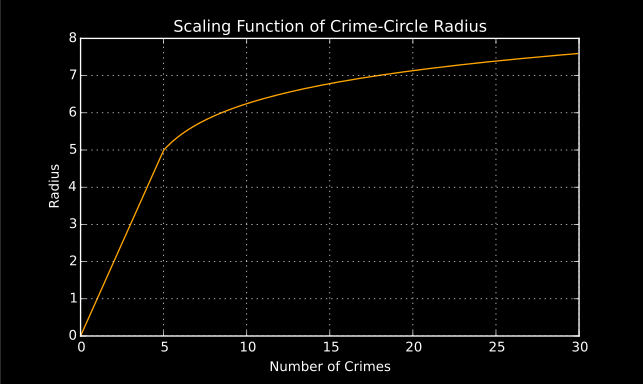
Crimes that happened at the same street corner have been grouped together and is displayed as a circle. Furthermore, we wanted to reflect the number of crimes in the size of the circle. Since the number of crimes at one street corner can be excessively large, depending on the active filters, we had to find a suitable scaling function. The chosen function returns the number of crimes + 0.7 as the radius, as long as the number of crimes is below 5. If the number of crimes is 5 or higher, the radius corresponds to ln(number of crimes - 3) + 4.3. The function is also plotted in the figure below. Note that the number of crimes is discrete and the plot below shows results for continuous values.